- Home
- All Episodes
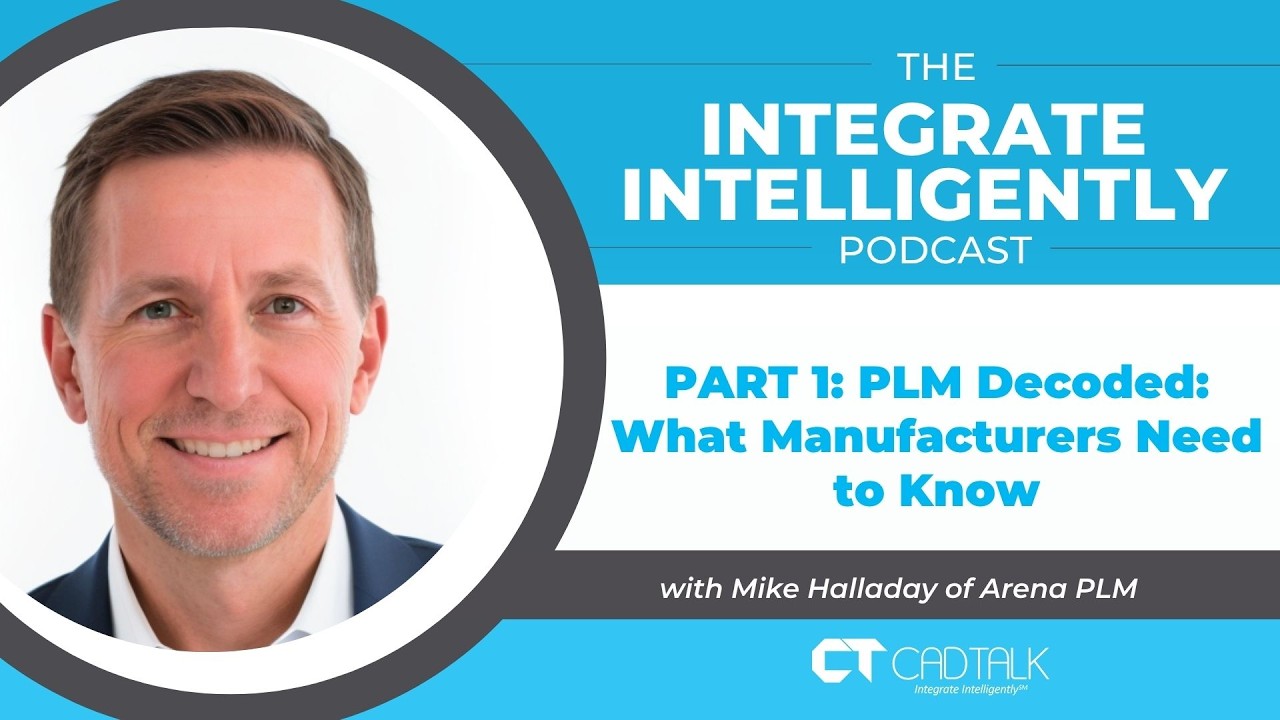
- Arena PLM: What Sets It Apart & Manufacturers Are Taking Notice – Mike Halladay of Arena PLM, Part 2
Arena PLM: What Sets It Apart & Manufacturers Are Taking Notice – Mike Halladay of Arena PLM, Part 2
{"email":"Email address invalid","url":"Website address invalid","required":"Required field missing"}
Full Episode Transcript
Mike Halliday, Arena Solutions (Segment 2) — What Sets Arena PLM Apart
The Integrate Intelligently Podcast — with Jeff Brickler, Scott Brickler (CADTALK), and Mike Halliday (Arena Solutions / PTC)
Mike Halliday, Solution Consultant at Arena Solutions, returns for segment two with Jeff and Scott Brickler — this time digging into what actually differentiates Arena PLM from other options, how it handles compliance and regulated industries, and where Arena is headed with AI and supply chain intelligence.
Speaker note: same setup as the other episodes — Mike's lines are attributed by name, and Jeff/Scott's lines are labeled generically as "Host."
Welcome Back & Episode Overview
Host: Welcome back to the Integrate Intelligently podcast. We're picking up with segment two with Mike Halliday from Arena Solutions Consultants. Mike, thanks for joining again — great to see you. Today we're centered on highlighting you and the company you work for, Arena PLM. Last episode we talked about what PLM is, what kind of companies use it, and how it differs from PDM and ERP. This time, I want to get into: there are a lot of PLM options out there — we talk to plenty of them through our ERP integrations — so if you're a manufacturer evaluating PLM, what makes you land on Arena? What business are you in, what problems are you solving, and why Arena over the alternatives?
What Makes Arena Different From Other PLM Options?
Mike: Great question — you've got a lot of choices out there. First and foremost, Arena is a multi-tenant SaaS application. We were the first of our kind — we started in 2000, and we've been in the cloud the entire time we've been in business. The obvious benefit is you don't need to maintain IT infrastructure to use a cloud application, so you eliminate those costs. But digging deeper, there are PLM-specific advantages too.
Number one: you have access to the application no matter where you are. That's always mattered for companies that design and manufacture products, since there's a lot of travel involved — especially if you use contract manufacturers. So accessibility is important.
Let's dig into the contract manufacturer side specifically. Once you've established who your contract manufacturers are, you need to get materials to them. Traditionally, that meant building a package — however you deliver it, whether a Dropbox link or an email with a huge attachment — and putting it somewhere the contract manufacturer can get to. The problem is that becomes a copy of the product record, and it has an expiration date built in. It ages, and over time it's no longer valid.
Host: As soon as you email it, it's already invalid.
Cloud-Native Since 2000: Why That Matters for Contract Manufacturers
Mike: Exactly — it's attached to the email. Anything that's a copy of the original record will eventually become invalid, and you're left trusting the people on the other end to keep track of what's the latest version. That's where a lot of mistakes happen — someone builds to a superseded revision, sends you a bunch of parts, you run all your testing, and it's wrong. That costs money and time, and time is money.
Because we're multi-tenant SaaS, not only can we access the application anywhere, we can grant your suppliers access to it too. We've built supplier access directly into the product — not a different way of logging in, everyone still goes to app.bom.com and hits the same login screen — but we've set up permissioning with canned access levels for suppliers that differ from access levels for employees or partners. Suppliers come in with filters automatically applied: they get direct access to the real record at its latest effective revision, but they're limited in scope. Grant them access to a specific part number, and that's all they see — not your full data set. If some attached files are marked not visible to suppliers, they simply won't see those. They don't see other suppliers, they don't see costs — just the information they actually need.
Configurable vs. Customizable: Faster Time to Value
Host: Being in the cloud since 2000 was early — I don't know that many people were thinking about cloud back then.
Mike: It really hit home during COVID. Everybody was working from home and needed to just go to a website to access the application — things that were nice-to-haves before COVID suddenly became essential. But back to your original question on what differentiates Arena: if you're a company that needs a quick start, Arena is a configurable application, not a customizable one. This won't be your bespoke PLM system. We have pre-built processes and objects, and we configure them for your use — your item categories, the attributes you track on those categories, your routings for change management, your quality processes. All of that is configuration, without the lengthy implementation process that comes with a fully customizable system. We quote implementations in weeks, not months.
Host: So that gets you to time-to-value faster — customers can get it up and running much more quickly than standing up a fully customizable product.
Mike: Right. Another aspect: everybody's on the same version of the application. We push updates to everyone, so when you log into app.bom.com the day after a release, you get a splash screen showing what's new, and you can tour the new features. In most cases those features have an opt-in — if you're heads-down on a project and don't want to deal with something new right now, you just don't opt in. At your leisure, you flip the switch.
Host: That's a nice approach — we do something similar when we can.
Compliance, Quality, and GovCloud: How Arena Handles Regulated Industries
Host: I know you handle regulated industries — FDA, ISO, and government, including a GovCloud offering. How does Arena handle compliance, and how does the quality module tie into that?
Mike: There are a lot of layers to compliance. Starting with regulated industries — a lot of that compliance is document-based, procedural compliance. It doesn't specify what your procedures have to be, just that you have to have procedures and show you follow them. That's largely document-based, and the same way we manage the product record — parts, BOMs, revision control — we also manage revision control on documents. Under a document object definition, you might have more than one file: the source document and the PDF everyone has access to, for example. You need to make sure both files under a given document revision are at the same level. That's how Arena handles revision control on procedural documents.
Tie that together with quality processes — a QMS covering RMAs, complaints, non-conforming materials, anything that flags a product issue — and the processes to act on it, like CAPAs and SCARs, are all managed through the quality application in Arena. On top of that, for governmental and export controls, we have a deployment of Arena in AWS GovCloud that meets the requirements for companies making products for the defense industry and other export-controlled industries.
New Features: Supply Chain Intelligence & AI in Arena
Host: Before we wrap up — what are some recent things customers are excited about from Arena? Beyond CADTALK, of course.
Mike: Beyond CADTALK — well, CADTALK is legacy for us at this point, we've had a couple years of integration, it's part of our core capabilities now. Looking at the past year of updates: a lot of it's been focused on supply chain intelligence. Think about all the off-the-shelf components you manage, purchase, and stock — a huge part of the job is just understanding the risk tied to those components. Are there PCNs against it? How much stock is available? What's the country of origin, and are there new tariffs affecting it? Is it going end-of-life? A PCN should project roughly when something will go end-of-life, but if you're not tracking that yourself and don't have a reminder set three months ahead, supply chain intelligence will track it for you and surface risk on components that are going obsolete or have limited availability.
The other big area is AI. To date, what we've implemented centers on help — using natural language to ask "how do I do this in Arena?" and it searches all the help content and brings back the relevant procedure, with an option to watch a video. Moving forward, we've got a release coming out in two weeks that adds AI to search. We have two search modes today: basic keyword search, like Google, and advanced search where you enter specific criteria and expect a narrow set of results. We're adding AI assist to advanced search, so you can use natural language to ask for exactly what you need. After that, we'll start adding agents into the process.
The other place we've used AI heavily is supply chain intelligence — not just assessing risk, but finding the next thing to use. When we identify high-risk parts, we use AI to find function-based alternates for components that are going end-of-life or otherwise unavailable.
AI for Alternative Parts and Supply Chain Risk Management
Host: That's a genuinely different use case. On the ERP side, from a manufacturing perspective, figuring out alternative materials or form-fit-function changes is tedious enough that you usually only do it when you absolutely have to. But when AI can do that at scale, it opens up possibilities that just weren't feasible with people doing it manually — you could switch materials almost on the fly when there's no form-fit-function change, something that used to take a lot of manual work and can now be evaluated almost instantly at the part level.
AI Document Summarization and Change Order Review
Mike: That reminds me of another use case we already have built in: summarizing documents. We can take a 100-page document and have AI generate a summary. When items on a change order have updated documentation, you can use AI on that change order to get not just a summary of the document, but a section on what specifically changed — which makes reviewing a change much easier.
Host: It's the best pattern-recognition tool we've ever created. Every company has some kind of AI feature now, from the CRM we use to PLM to our own product. What's the feedback been from customers around data? When everyone moved to the cloud, people were worried about data integrity — who can get to my data. Now with AI, all the big providers want you uploading your data for training. Have you heard concerns from customers around that — about training data, or their data going to someone else? I've heard some manufacturing customers talk about wanting to roll their own models, with their own infrastructure to keep their data in-house.
Data Privacy Concerns With AI: What Manufacturers Are Asking
Mike: Absolutely. There are AI applications, and there are also analytics applications for assessing your own data — Arena has an analytics package, and we analyze that data on a regular cadence to feed the charts customers build in analytics: change orders and cycle times, quality by product, quality by supplier, that kind of thing.
Host: Mike, this has been a great conversation. I'm conscious of your time, and we covered a lot. Since you represent Arena, and I learned some things here today, this was genuinely great. How can someone listening who wants to learn more about Arena — maybe they're stuck in spreadsheets, folders, and email, it's always the same story — find you or find Arena?
Mike: First and foremost, go to arenasolutions.com — that's our commercial site. You can make requests right from the site, ask questions through our bot, and see all our blogs, features, functionality, and our partners page, which includes CADTALK.
Host: Awesome. Thanks, Mike — I learned something today, which is always a good day for me. Thanks for joining the Integrate Intelligently podcast. We really value the partnership and the conversation. For everyone listening, please subscribe, go check out arenasolutions.com, and look up Mike Halliday on LinkedIn if you want to connect. Until next time, Mike — appreciate the conversation, and we'll see everyone next time.
Mike: Sounds great — thanks, guys, I appreciate the opportunity to talk with you.
Host: Thanks, Mike.
CADTALK for IFS Cloud uses artificial intelligence (AI) to automate the transfer of engineering bills of materials (eBOM) from virtually any CAD, PDM, or PLM application into IFS Cloud for manufacturing routing. All of this can be done in minutes, reducing the handoff from engineering to manufacturing by 80% with a return on investment in about two months.
How does it work?
CADTALK generates bills of materials, routing operations, items, inventory records, and other data inside IFS Cloud. Support for document management, materials and routings is possible right out of the box. CADTALK creates ongoing bi-directional dialog between systems to take design intent to complex manufacturing execution seamlessly.
What are the benefits?
As the official partner for IFS Cloud, CADTALK implementation is fast and no customization is required.
- Automatically create new inventory parts and product structures
- Quickly generate and update BOMs
- Create rules-based manufacturing routings
- Open API and native configuration capability
- Improve accuracy
- Reduce purchasing errors
- And so much more.
Contact CADTALK today to learn more and get started today.
CADTALK is an IFS Gold Solutions Partner and the official partner for IFS Cloud.