

Ask a manufacturer how many hours a week the team spends moving engineering data into the ERP by hand. Most can’t answer. The work is real and constant, and almost no one has ever put a number on it.
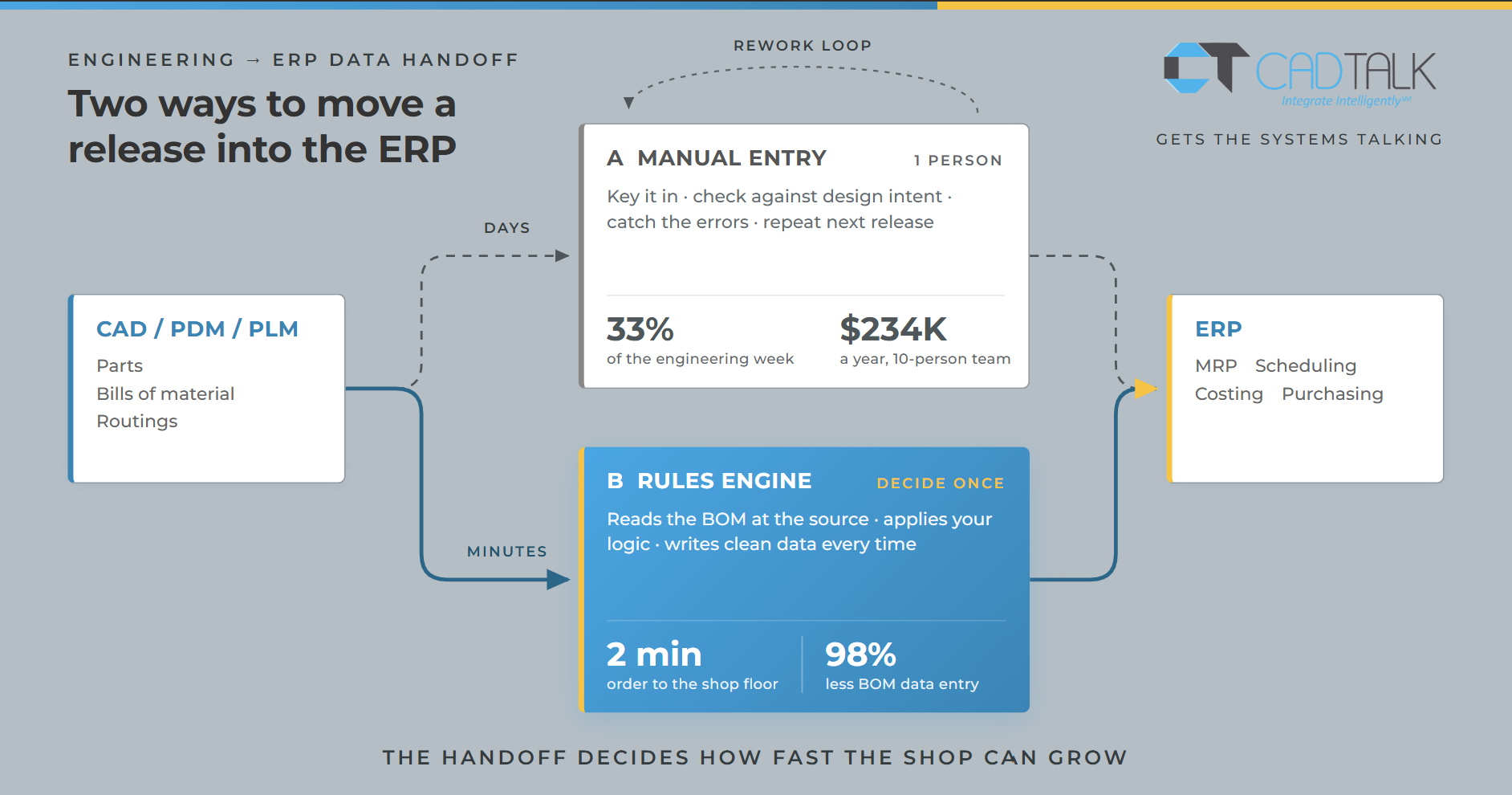
The pattern is the same everywhere. Engineering finishes a release, and a person, often an engineer who would rather be designing, keys the parts, the bills of material, and the routings into the ERP.
Then they check it against the design intent and catch the errors before they reach the floor. Every new project adds another round.
Industry data puts a size on it. Engineers spend close to 33% of the week on non-value-added work like this, according to a Tech-Clarity survey of roughly 250 manufacturers. For a 10-person engineering team, that lost capacity is worth about $234,000 a year in engineering labor.
The cost hides inside job descriptions and long nights before a deadline, so it never reaches the P&L as its own line.
The person in the middle sets your ceiling
A shop which depends on one person to feed the ERP can only move as fast as that person can type.
The person is a queue. Nothing downstream starts until the release is keyed and checked, so purchasing waits and production waits.
When the queue owner takes a vacation, the whole flow turns fragile, and the business feels it.
Adding headcount looks like the answer. Hire someone to keep the ERP fed until the next growth spurt, then hire again.
This buys human capacity for a task that never needed a human in the first place. The cost climbs with the company, and the bottleneck comes right back.
Let software handle the repeating
People are good at deciding how something should be done. People are bad at doing the same thing the same way a thousand times. Boredom creeps in, attention drifts, and Friday afternoon looks different from Monday morning.
Software has the opposite profile. It runs the same rule at 2 a.m. that it runs at 9 a.m., without getting tired or cutting a corner.
When it makes a mistake, it makes the same mistake every time, so you can find it and fix it once. Human error is random and stays invisible until it surfaces downstream as a wrong part or a rework cycle.
So decide once how the engineering-to-ERP handoff should work, then let a rules engine do the repeating. A configurable rules engine reads BOM data straight from the CAD or PDM environment, applies the business logic the shop already follows, and writes clean, accurate data into the ERP.
The engineer stays in the design tool. The data flows on its own.
That also opens doors manual entry kept shut. With the handoff automated, a shop can test 50 routings for a part and keep the cheapest, or reroute around a machine that just went down, rather than settling for the one routing a person had time to enter.
Speed is the part the customer sees
A customer judges you on the delivery date. The rework and the expedites behind it never reach them.
This makes lead time the number worth defending. Every hour you compress between an engineer’s decision and a finished part shows up as an earlier delivery, and earlier deliveries win the next job. CADTALK moves an order to the shop floor in 2 minutes, production environment, not a demo.
Clean data is also what lets the ERP do the job it was bought for. Scheduling, planning, costing, and MRP all run on the bill of material.
The platform is capable. Give it accurate, timely data from engineering and it delivers what it was built to deliver. The ROI gap most manufacturers feel comes from the data feeding the system, upstream in the engineering handoff.
Where this starts
This starts small. Pick the one release type you handle most often, where a mistake causes the most rework, and write the rule for it once.
Then watch it run and adjust. Crawl, walk, run.
At the shops pulling ahead, the best engineers set the rules and let the handoff run. They design, and the ERP runs on data it can trust.
The exceptions get a human. The manual handoff is gone.
CADTALK gets the systems talking. It reads BOM data straight from CAD or PDM, applies your rules, and feeds the ERP clean, accurate data without a person in the middle: 98% less BOM data entry, and a payback of 2 to 4 months on engineering time alone. See what the handoff looks like when it runs itself at cadtalk.com/demo.