
- Home
- All Episodes
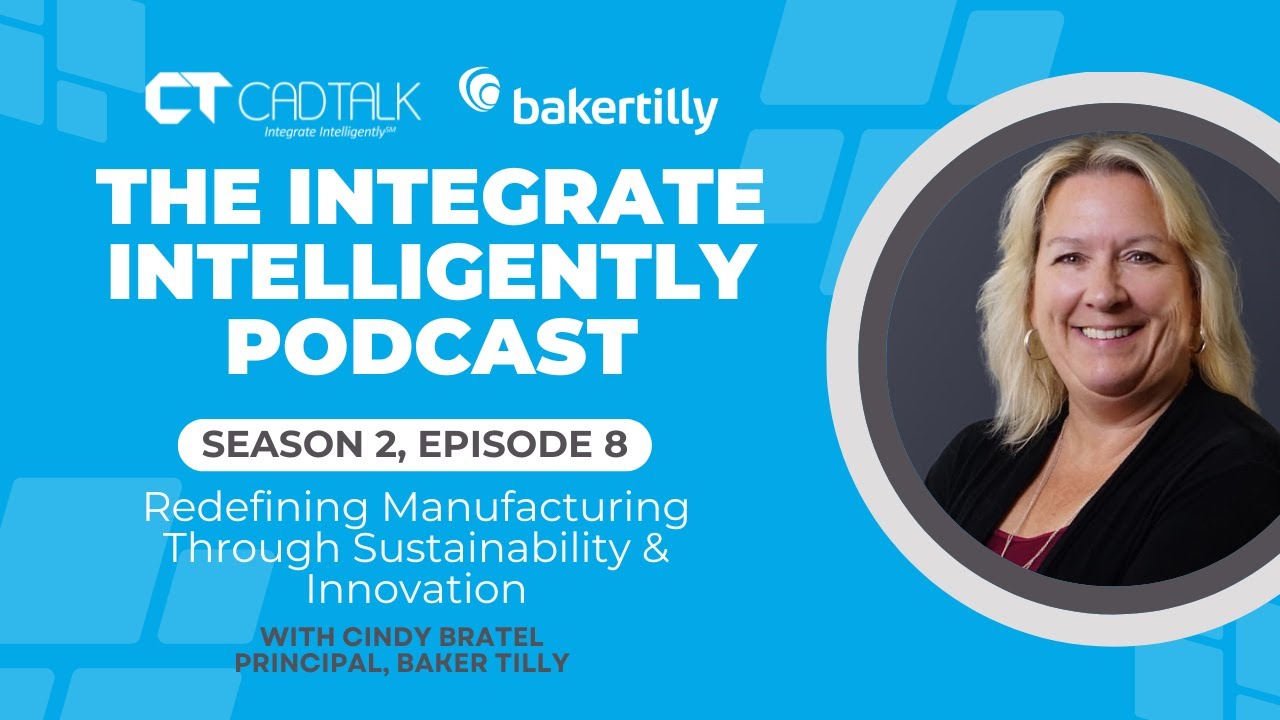
- S2, E8: Redefining Manufacturing Through Sustainability and Innovation w/Cindy Bratel of Baker Tilly
S2, E8: Redefining Manufacturing Through Sustainability and Innovation w/Cindy Bratel of Baker Tilly
{"email":"Email address invalid","url":"Website address invalid","required":"Required field missing"}
Join Jeff Brickler, Scott Brickler (CADTALK CEO), and Cindy Bratel (Baker Tilly) for an in-depth discussion on sustainability in manufacturing. This episode explores how technology is driving environmental transformation in the industry, the challenges facing manufacturers today, and how companies can leverage sustainable practices for competitive advantage. From circular manufacturing to ESG reporting requirements, discover how modern ERP systems and data management are reshaping the future of manufacturing.
Full Episode Transcript
Redefining Manufacturing Through Sustainability and Circular Production (S2 E8)
The Integrate Intelligently Podcast, Season 2, Episode 8 — with Jeff Brickler and Scott Brickler (CADTALK), and Cindy Bratell (Baker Tilly)
Jeff: Welcome back to Season 2, Episode 8 of The Integrate Intelligently Podcast. I'm your host, Jeff Brickler. Today we're joined by my usual companion Scott Brickler, CEO and founder of CADTALK, and by Cindy Bratell of Baker Tilly Digital Services. Our topic is redefining manufacturing through sustainability and innovation.
Cindy: Thanks for inviting me, Jeff and Scott. Appreciate it.
Jeff: Cindy, you've worked with ERP and technology for a number of years, with a background in project management. Is that where you got your start?
Cindy: My start was really in IT — long ago, moving companies from mainframe, from big blue IBM, into client-server technology. That dates me in terms of years in the industry, but I've always been in the manufacturing space.
Jeff: Did you start in manufacturing itself, or in IT and consulting?
Cindy: I started in IT. I have an IT undergrad and a master's in production and operations management. I moved into consulting very quickly, did some time with a Big Four firm, went back into industry, and I've been with Baker Tilly for the last 18 years.
Scott: How did you end up in manufacturing? A lot of things in life are coincidental — you just end up places.
Cindy: I used to speak to high school students about careers in computing, and they'd always ask how to get where I am. You can't plan it. It presents itself and you make choices along the way.
For me, I took an internship in college with a manufacturing company here in Wisconsin. I also gravitated toward production and operations management classes in my undergrad and really excelled at them, so I knew something about it clicked. Between the technology and the manufacturing, that's how I found my way into this career.
Jeff: That's similar to Scott's background — we called them co-ops at the university we went to, but the same idea: an internship at a manufacturer that gave you experience in the industry.
Manufacturing in Transformation
Jeff: You've written an article recently about sustainability, and I know IFS and Baker Tilly both focus on it. Help educate me and our listeners: what is sustainability in this context, and why is it critical for manufacturers?
Cindy: Let me take a step back on my role. I lead our IFS solutions global practice at Baker Tilly Digital. We became a formal IFS partner around 2018, and we've grown a practice serving two markets — North America and out of the UK for EMEA. So we have an international footprint, with a team of about 140 people across regions including Sri Lanka. One of the best IFS professional services teams out there, in our opinion. Not that I'm biased.
My career has spanned more than 30 years in manufacturing, both serving clients in a consultative way and working inside manufacturing companies. That first company where I was in IT was Sta-Rite Industries here in Wisconsin, now Pentair Water Processing — they were acquired a number of years ago. Then, going in and out of consulting, I spent years at Dana Corporation in automotive running their aftermarket business, and at Carrier in HVAC doing supply chain strategy.
So having seen a lot of industry subsectors from both sides of the fence, here's what I see. Manufacturing is going through a fundamental transformation right now, driven primarily by technology, but also by sustainability concerns, changing customer requirements — customers are getting smarter and more demanding every day — and the need for supply chain resilience. That transformation creates challenges and opportunities, and it requires manufacturers to adapt and innovate to stay competitive in a very large, evolving global market.
There was a time when manufacturers stayed in their home country. It's rare now to find even a small manufacturer doing no business internationally. So what we do in North America is no longer the only set of rules we follow.
You've got Industry 4.0 driving technology innovation. You can't be in the IFS ecosystem without hearing AI, AI, AI — that's the buzzword right now, both in technology generally and in that ecosystem. For many years we've been very focused on IoT: how do we connect the shop floor into the ERP or whatever system, to collect that data? And then sustainability and supply chain resilience, which the pandemic emphasized. We all experienced supply chains shutting down and timelines extending. With all of that changing at once, manufacturers have to be much more on their toes.
Jeff: Even the smallest US manufacturers have a global footprint in some regard, if only because they sell internationally or have production elsewhere. And every country has its own regulations around sustainability, manufacturing, and the environment.
What Historically Held Manufacturing Back
Jeff: What do you see as the limitations of the systems manufacturers have today, and the challenges and opportunities around sustainability?
Cindy: Historically, production systems treated resources as if they were infinite, and a lot of waste was considered acceptable and inevitable.
And you mentioned politics — we won't get through this conversation without some of what's going on in this country coming into it, because it's centered on bringing manufacturing back to the States in some form.
But whether or not you believe in global warming, resources are being depleted all over the world. If you don't feel it in temperature shifts — I live in Wisconsin, I'm used to feet of snow all winter, and we did not have that much snow this year, part of a decline over time. Then there's pollution. Think back to the start of the pandemic and the satellite views of California before and after everything shut down, and how differently you could see it without the smog from all the equipment and machines running. The ecosystem damage is real. Whether it started in North America or somewhere else on the globe, we all have pressure to think about it.
So these systems have historically thought about profit over sustainability, and there's a major shift now toward leading with sustainability practices and not having a negative impact on our environment. All of us want the world in a good place for the kids and grandkids and great-grandkids.
Part of that shift is toward more sustainable production methods, including what's called the circular economy — which is difficult for people in manufacturing to get their heads around. Even for me, because you don't see a lot of it right now. There are hundreds of millions of manufacturers around the globe. How many are really in a circular economy? But these are concepts that will keep growing in adoption over time.
The Secondhand Smoke Analogy
Scott: The way it's taking hold reminds me of how smoking became unpopular. When it was just a person hurting themselves, it couldn't get much traction. As soon as the story changed to secondhand smoke and how it affects other people, everything shifted, and now smoking is almost taboo.
I see the same thing with environmental factors. It isn't an isolated incident, it's a global problem we have to address — otherwise it affects your children and the next generation. That hits home and changes behavior. You change the image in people's minds, which changes demand, which puts pressure on suppliers to do something different.
Cindy: Exactly. We're all interconnected, and that's what's happening. The secondhand smoke example is a perfect analogy for what we're seeing.
Jeff: Regardless of the politics — whether we should have manufacturing in the US, globalization or not, global warming or not — we can say we want cleaner industry. I live in a house that's 150 years old, and we've had to deal with lead paint. That's the result of past practices. I'm not saying it was anyone's mistake, but we have to deal with these things, because we only live on one planet. What happens in America or anywhere else has an impact elsewhere.
Cindy: It's about education, which is what you're doing with this podcast. We didn't know what lead paint was doing to us healthwise. We didn't know what making products with asbestos would do to people over time. We've had lessons from history, and there are more to learn. People will make their own decisions about what they believe, but reality is reality.
Scott: Lead damages kids and asbestos causes cancer. Those aren't really debatable.
Circular Manufacturing in Practice
Scott: On circular manufacturing — back when I was still in consulting, one of the more interesting processes I got into was a company that did demanufacturing. They recycled computer systems from government facilities, breaking the computers back down to their core elements, pulling the gold out, everything. I remember trying to model that in the ERP, and it was a completely different way of thinking. It blew my mind. And I kept thinking that's a problem that will become the norm rather than the exception. Is that what you mean by circular manufacturing?
Cindy: It is. Minimize waste, maximize resource efficiency.
And to be honest with you, at Dana Corporation in automotive we used to recycle what we called cores. We had a department that literally pulled the cores out of products we were selling, because they were costly and could be reused. Maybe we did it for different reasons — it was profit driven, like I said earlier — and now people think about it from a sustainability perspective. But it's the same concept.
We also built oxygen sensors at Dana that use platinum, a very expensive precious metal, and we recycled the platinum on reusable oxygen sensors because the cost mattered. Again, the underlying driver was profitability, but the activities are the same processes. And to your point, we've got to have the capabilities and technology that make it easier.
Scott: It's beautiful when the economic factors and the sustainability factors align. You can get people to do things because it's the right thing to do, sometimes — but if you can affect the pocketbook, they tend to do it more often. Let greed work for you, in that respect.
So if technology creates a dynamic where recycling that core or recovering that platinum actually benefits you economically, and it aligns with sustainability practices, that's a win all the way around.
We had a podcast recently about supply chain where we talked about large economic levers that change behavior. I always think technology is one people don't recognize as a lever. Technology can shift the way you do things almost the way policy does. If it becomes easier to pull that core or reuse that platinum, you'll do it, and the economics align with sustainability. Until you have the technology, it doesn't matter — you can't do it.
Jeff: That reminds me of growing up in my dad's garage. Scott and I came from a more blue-collar background, and working on cars you'd pay a core charge up front, and to get your money back you had to bring the old part in, so they could recycle it or recondition it and resell it. Same idea, just on a larger scale.
Cindy: It is, and more sustainable now. Those were pretty manual processes back then — people tracking things on paper, hard labor. It's much more automated today.
Scott: Speaking of your dad's garage, that's coming back. I see a lot of young people wanting to work on cars again and repair their own. It's not a lost art.
Jeff: When you mentioned oxygen sensors, I thought of catalytic converters — people steal them for the platinum inside. There's a storyline in Tulsa King, with Sylvester Stallone, where they steal catalytic converters and sell them. A funny example of recycling used for a nefarious purpose, but it works, because platinum is expensive.
Cindy: Not the behavior we're looking for in manufacturing.
What IFS Has Built for Sustainability
Jeff: Can you talk about how technology, and IFS specifically, enables sustainable manufacturing and those closed-loop systems?
Cindy: The sustainability opportunities with IFS have been pretty interesting. A few things they've put into the application:
There's a sustainability management module, focused on simplifying the reporting and management of your sustainability data — one central location for the data, a catalog of KPIs you can use to set long-term organizational goals.
There's an emissions tracker, which lets an organization mitigate its own environmental impacts. How do you track and understand the emissions you're putting out? That's becoming more of a requirement. We talked about international rules and regulations, and that's also what drives it back to us in North America. If you're going to do business internationally, those reporting metrics matter.
There are ESG lobbies in IFS Cloud. A lobby is IFS's term for a dashboard. So you get built-in metrics right on your dashboard for people working in occupational health and safety, training, or employee management.
And the last one is support for circular manufacturing — the remanufacturing capability in Cloud, which IFS introduced a number of years ago. I remember an IFS customer event where they set up a whole circular manufacturing playground inside the event so you could see how it works.
When you think about circular manufacturing, how do you enable high usage and control of reused components? It takes a whole shift in mindset, and it starts with R&D and the engineers in an organization — a group of people you work with very well at CADTALK. That's where it starts: how do I build products, and use raw materials, that can be reused in the next manufacturing cycle? Ultimately reducing waste, reducing energy consumption, and operating production much more efficiently.
Where Baker Tilly Comes In
Cindy: We've found this to be a marriage made in heaven from a Baker Tilly perspective, not just a digital one. As a multi-billion-dollar professional services firm serving a broad client base, one of the things we've brought to market is ESG initiatives and services.
One of the first things we do is help clients sit down and understand how to even start collecting the data to know where they're at from an ESG perspective. You can't have a plan and grow if you don't know where you're starting from. And one of the most fundamental things IFS has put into the application is the ability to collect that data.
Scott: You have to benchmark before you can change. It's like getting on the scale in the morning — you can't lose weight without getting on the scale.
Cindy: Well, you can. You just won't know it.
Starting From Scratch
Jeff: Say I'm a manufacturer and I know I should be doing something about sustainability, and I can see the opportunity in circular manufacturing, but I'm not on IFS today and my current system makes tracking too hard. What does that journey look like?
Cindy: It starts with awareness and education, and those are services Baker Tilly offers.
People enter this ESG space asking what they have to do, often because they want to enter an international market and have to prove some of this out. Understand that the pressures internationally are going to come to the US. It isn't a requirement to do business here today — though it is in some subsectors, and for many customers — but it is a requirement internationally, and there are laws and regulations around what you have to do.
So when a client doesn't know where to start, we begin with awareness and education and put a program together. For clients with a more sophisticated strategy, it's about developing and refining it, and preparing for reporting — because you have to report to your customers and in some cases to the government of the country you're operating in.
Like you said, Jeff, most companies aren't there. Many are on old ERP systems or best-of-breed platforms. Not everyone is on IFS Cloud, even though we'd love everybody to move to IFS Cloud. But if you're not there yet, you still have to start collecting. It doesn't matter whether you have the system — if you have no information, you can't report. You can report manually, and hopefully we get you to automation as you grow.
We also do assurance readiness: identifying and implementing the processes that actually control sustainability reporting. It isn't one and done. You start somewhere, but you have to have those processes laid out in the business, and we help clients think about how to sustain them. Then strategy — what are your targets and goals, what's your decarbonization strategy, what about technology implementation?
One thing we do internally is a monthly meeting with all our IFS solutions team members, and in the last year we've brought our ESG team into that meeting to teach us about those services and how we can collaborate. Lots of cross-collaboration, because we're all talking about the same thing from different angles.
What's Actually Driving This
Scott: Are most of these initiatives driven by companies expanding into countries with stricter rules — if you want to do business here, your carbon footprint needs to be X?
I think of similar examples. We started hiring internationally and needed to understand labor laws, which pushed us to get more sophisticated with our HR software. Or Avalara in tax software — when the legislation changed, I think there was a lawsuit that drove the sales tax problem, and they were there in time with the solution everybody suddenly needed. They rode that wave. This seems like it could be the same type of thing.
Cindy: Great question, and yes, that's one of the factors. Even the smallest US-based company could be doing business internationally, and there are pressures coming from European markets that have laws and requirements around this.
But something else I started to notice is the Gen Z group. They're very interested in sustainability and in not consuming our precious resources. So you have two factors converging into the same pressure — the business side and the people side.
Going back maybe five years, interviewing individuals coming off campuses, the questions changed. They want to know about your sustainability commitments. What does that look like? There's pressure not only on a professional services firm like Baker Tilly out consulting, but everywhere. You see that shift in the next generation's beliefs and values, and they're putting pressure on companies too. They want to work for a company that cares about what it's giving back.
I also think the pandemic had an impact. The world turned upside down and it changed people's thinking in so many ways — how we came together as a global community, and what that means for us as a society. And then fundamentally you have aging machinery and infrastructure, so when you go to buy new, the people selling to you are asking what's important to you, which forces manufacturers to get smarter about their options.
So there are a lot of factors. Regulations around the globe are the starting point, but number two is Gen Z pushing from the people side.
Scott: The regulations are probably being driven by that too, because people vote in the leaders who make the policies. It all comes from that sentiment.
And your point about the pandemic is great. It gave us a view of the world we hadn't seen in years. Generations went along with the way things were, and then everything shut down and you could see what we'd been doing. Wow, there are actually mountains in California — I couldn't see them half the time. It uncovered that there's a material effect to the choices we made, and that it hasn't always been this way.
Jeff: The other insight from the pandemic was how small the world got. Something that started, from our perspective in America, very far away could affect us thousands of miles away. Environmentally it's the same. If you're producing pollution somewhere else, or you're not being responsible, it affects everybody. Maybe that's part of it too — the realization that the world is smaller than we think and we're all living the same lives.
Scott: You come together within a country or a city over political things, but this was everybody coming together across the world.
Data Is the Foundation
Jeff: Anything else you'd like to share that we haven't touched on?
Cindy: Maybe going a bit deeper on data and how critical data management is, because it wraps around everything we've been discussing.
Let's face it, data is king these days. Collecting data around ESG reporting especially. Where are you spending your capital on sustainable initiatives? The companies you do business with want to know, so you have to be able to collect it. Greenhouse gas emissions, KPIs around that, energy consumption. Those are quantitative — you can get your arms around them. But there's also qualitative data: surveys with employees on working conditions, customer satisfaction.
When you think about IFS and its intersection with Microsoft Power BI, being able to capture data and then actually use it is another benefit of IFS Cloud. Data is king, data is key, it's fundamental. You can't do your reporting, and you can't know where you need to improve or how to refine your strategy, if you aren't measuring.
Jeff: That matches conversations we've had with other ERP folks, especially around AI. If you don't have the volume of data and the data quality, you can't leverage AI — AI is built on data. That's why they build the data centers. I was listening to a podcast about the different levels where you can invest in AI, the chip level and the data center level, and it all comes back to data. So making it easier to collect that data, with better processes and more consistency, is how you leverage all of that information to make better decisions.
Cindy: Agreed. It's part of why our digital services have shifted and grown. More and more clients come asking for help with data governance, to keep data clean and manageable, because you're not going to take on AI as a manufacturer or any other business without that clarity.
The Workforce Question
Cindy: We also haven't talked about the people side, and part of what's driving all of this is the lack of capable resources in the workforce.
A decade ago we were talking about what was coming as baby boomers retired and that large generation exited the workforce. We had to think about automation. Then the pandemic came along and accelerated it — even people who were hanging on opted to step out. So what we thought would happen is quite different from where we've actually landed.
And that brings us to where we are in North America with the tariff conversation and the intent to drive manufacturing back into the US. No matter what we think, the change in what we do in manufacturing is going to be driven partly by that. The reality is you're not going to reopen steel factories built decades ago. The technology isn't there, and you aren't going to find people who want to come back into those environments at the pace and scale needed. So automation, remanufacturing concepts, and making this more circular and sustainable will get pushed harder and harder in the coming years.
Scott: Great point. Manufacturing won't come back the way it was. It'll look completely different. It will come back, but nobody really knows what it'll look like. And those things will matter, because people don't want to be in environments that cause those issues. There's going to be a lot of creativity out of this problem — there's an opportunity in every catastrophe. Never let a catastrophe go to waste.
Closing Takeaways
Jeff: As we wrap up, maybe each of us shares one thing that was new. I'll start. Cindy, what you said about the pandemic and how it influenced Gen Z was insightful. I hadn't thought about it that way, but the market pushes us to do these things, and Gen Z is a big part of that market.
Scott: Similar for me. We attribute things to the government, or politics, or a region — but it's actually just people, and their opinions and feelings drive all of it. We are the thing we're describing. What we believe and what we communicate to each other is what drives everything that happens. It's a reminder that even in this AI world, everything is still driven by people.
Cindy: For me, it's the reflection on events and changes in our economy and workforce. You can't see what's going to happen in the moment, but it's much easier to look in the rearview mirror. The lesson is that you have to embrace what's happening to some extent. Embrace AI. Embrace ESG technology and initiatives. None of us has a crystal ball, but reflection shows how those things shape our future.
I've been in manufacturing and technology for more than 30 years, and I never would have imagined seeing all the things I've seen, or how much life and business have changed. I'm excited to see what comes, and how Baker Tilly can help clients embrace that future — because it's a scary world for many companies, especially manufacturers that aren't fast adopters of technology.
Jeff: Cindy, where can folks find you and the Baker Tilly IFS practice? Baker Tilly is an enormous organization.
Cindy: There's a lot of information on our IFS solutions practice, our ESG initiatives, and our other services at bakertilly.com. We do a lot of webinars and information sharing that's free to the public, and we're always happy to have you join. You can reach me by email at Baker Tilly, and I'm on LinkedIn — always happy to connect and share ideas.
Jeff: There's also the IFS Connect event coming up in Nashville — June 2nd, 3rd, and 4th, with the event starting on the 3rd, a Tuesday. A good opportunity for listeners to stop by the Baker Tilly booth or the CADTALK booth and have a conversation.
Thank you so much, Cindy. This was a great conversation. You can find Cindy and Baker Tilly at bakertilly.com, and you can subscribe to The Integrate Intelligently Podcast wherever you get your podcasts. We'll catch you next time.
CADTALK for IFS Cloud uses artificial intelligence (AI) to automate the transfer of engineering bills of materials (eBOM) from virtually any CAD, PDM, or PLM application into IFS Cloud for manufacturing routing. All of this can be done in minutes, reducing the handoff from engineering to manufacturing by 80% with a return on investment in about two months.
How does it work?
CADTALK generates bills of materials, routing operations, items, inventory records, and other data inside IFS Cloud. Support for document management, materials and routings is possible right out of the box. CADTALK creates ongoing bi-directional dialog between systems to take design intent to complex manufacturing execution seamlessly.
What are the benefits?
As the official partner for IFS Cloud, CADTALK implementation is fast and no customization is required.
- Automatically create new inventory parts and product structures
- Quickly generate and update BOMs
- Create rules-based manufacturing routings
- Open API and native configuration capability
- Improve accuracy
- Reduce purchasing errors
- And so much more.
Contact CADTALK today to learn more and get started today.
CADTALK is an IFS Gold Solutions Partner and the official partner for IFS Cloud.