

- Home
- All Episodes
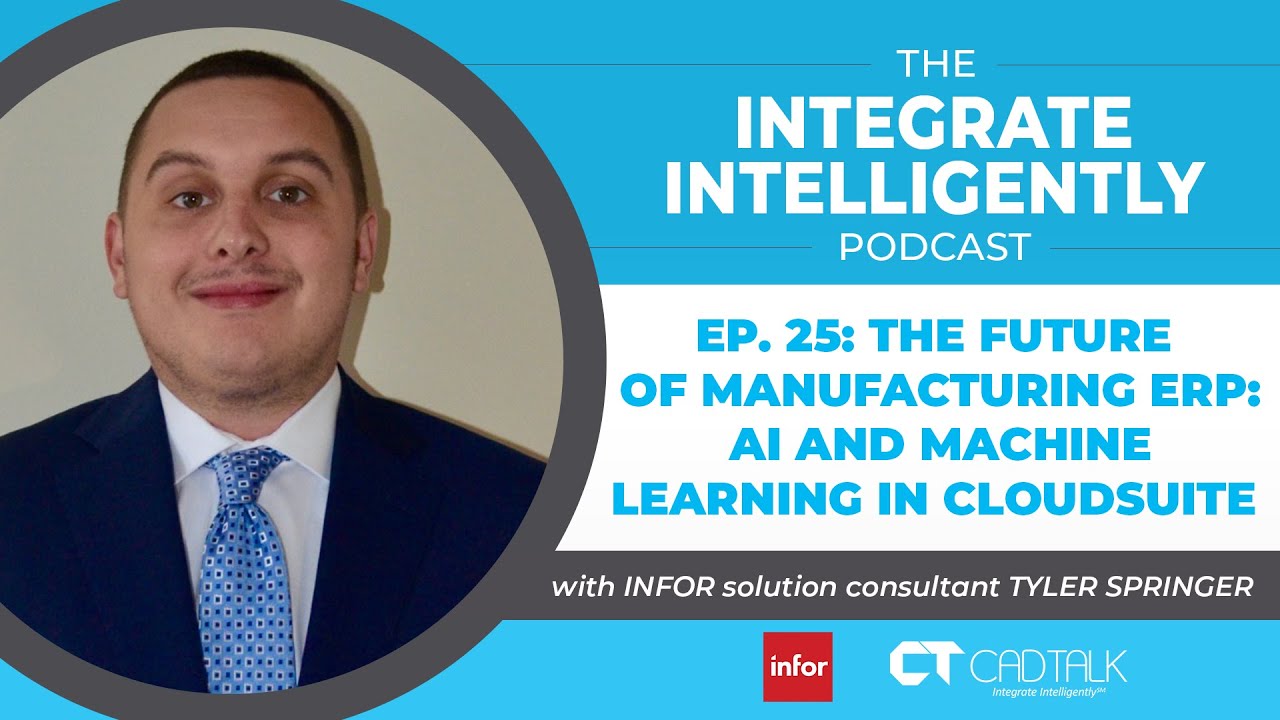
- Ep. 25: The Future of Manufacturing ERP: AI and Machine Learning in CloudSuite with Tyler Springer of Infor
Ep. 25: The Future of Manufacturing ERP: AI and Machine Learning in CloudSuite with Tyler Springer of Infor
{"email":"Email address invalid","url":"Website address invalid","required":"Required field missing"}
Join hosts Scott and Jeff Brickler and Infor expert Tyler Springer as they dive deep into how AI and machine learning are transforming manufacturing through Cloud Suite Industrial.
Tyler reveals his unconventional path to becoming a manufacturing tech innovator and breaks down the critical factors for successful AI implementation – from data quality essentials to real-world applications that are reshaping the industry today.
Whether you're a manufacturer looking to modernize or a tech enthusiast curious about industrial AI, this episode delivers actionable insights on navigating the future of smart manufacturing.
Full Episode Transcript
The Future of Manufacturing: AI and Machine Learning in Infor CloudSuite Industrial
The Integrate Intelligently Podcast — with Jeff Bickler, Scott Bickler (CADTALK), and Tyler Springer (Infor)
Jeff: Welcome back to The Integrate Intelligently Podcast. I'm your host, Jeff Bickler, as always accompanied by my brother, owner, CEO, and founder of CADTALK software, Scott Bickler. Scott, good to see you again. Today we've got a guest with us from Infor, Tyler Springer — welcome, Tyler. We're talking about the future of manufacturing at Infor — AI and machine learning within CloudSuite Industrial. Tyler, we start off every conversation the same way: the hero's journey. How'd you land where you are — how'd you get to Infor, what's your background, what's the origin story?
Meet Tyler Springer
Tyler: Absolutely — thanks, Jeff, and thanks to both you and Scott for having me today. My path to Infor has been pretty diverse. I've got a background in software engineering and a real passion for innovation, plus I picked up some business development along the way — my career's really been about helping organizations transform their operations through technology. Before Infor, I wasn't even in this space at all — I actually started at a startup called Plows and Mows, which people called the "Uber of snowplowing and mowing," based in Syracuse, New York, which gets a lot of snow. That was a small company, about 15 of us, and it taught me a lot about operating with minimal resources and minimal guidance.
From there I moved to a much larger organization, Bank of New York Mellon, as a tax specialist — that's where I really honed my analytical skills in Excel, working through complex tax adjustments. That gave me a deep understanding of financial systems and compliance that ended up being genuinely valuable later on with ERP work. My now-wife and I then moved from Syracuse to New York City, where I took a role as a 360 recruiter — we handled everything from landing contracts with companies like Goldman Sachs to actually sourcing the talent for those roles, mostly data scientists, data engineers, and data architects, all the way up to management level. That's really where my interest in the whole data world took root. A former colleague of mine moved from recruiting into Infor and eventually brought me over. So today, I've kind of combined all of that — recruitment, tax, financial systems — into helping manufacturers leverage intelligent systems, drive efficiency, and foster innovation.
Jeff: That's a genuinely diverse path — very different from what I usually hear. The standard ERP origin story is almost a cliché at this point: "I worked at a company that implemented an ERP, they put me on the project, and that's how I learned." That's most people's story. Yours is a lot different. What does your actual role at Infor look like today — are you consulting, sales, something else?
Tyler: Great question — it's been an evolving role, which has been nice. I support our partner ecosystem — CADTALK's actually one of our major partners we bring into a lot of opportunities, all the way through implementation, with companies across our partner network. I'd call myself a solution consultant or solution architect at Infor — my role is really about positioning CloudSuite Industrial, which is built specifically for industrial manufacturers, and increasingly now, positioning newer concepts like AI and machine learning — showing customers the real value behind those buzzwords, backed by actual use cases and ROI. That's where the "solution" piece comes in: helping customers use our platform to actually implement these AI and machine learning models alongside the rest of the software.
Jeff: Sounds like you've got a software background feeding that interest in AI and machine learning — I think you mentioned a software engineering degree?
Tyler: Actually, economics — but I've done a lot of boot camps in software engineering, different coding languages. I don't want to take too much credit from actual trained software engineers out there.
Scott: Same here, Tyler — I'm an industrial engineer who self-taught programming. I play a software engineer on TV. [laughs]
Jeff: Our team's always amazed at some of the things Scott knows, and then equally surprised he doesn't know more.
Scott: Just enough to be dangerous.
Jeff: Exactly — it's always interesting hearing how people land in ERP, since I've got a totally different background myself. Yours is unusual, but it clearly translated into real interest in the technology, and now specifically in how customers can actually use and leverage the CloudSuite Industrial platform.
Tyler: Absolutely, and you make a good point — ERP is never something you find at a college career fair. It's just not something that's ever really "positioned" to you as a path.
Jeff: No booth at the career fair saying "come work in ERP."
Scott: It's not the new hotness, like Jeff and I always joke — every new grad wants to work at Big Tech. "I want to work at Google, or Facebook, or SpaceX" — whatever the cool thing is at the moment.
Tyler: Right, but I think people who get into it realize how genuinely cool it actually is once they're in.
Scott: That's something I see a lot when we hire students straight out of college — a lot of them came in wanting to build video games, which is the most common answer. Then they realize those studios are basically sweatshops, honestly not that interesting day to day. But once you actually understand a problem, it gets more and more interesting the deeper you go. It's not what they set out to do, but once they're exposed to it, they realize — wow, these companies build all the stuff we use every single day, and I get to hear about all their real problems. You end up falling in love with the problem once you're actually exposed to it.
Jeff: I've mentioned before — I have a degree in Classics, Latin and Greek — and people always ask how on earth I ended up here. It's not that different from the ERP story, honestly. Scott makes a good point: your level of interest in anything tends to track your level of expertise in it. The more you know, the more value you can bring to other people, and the more they see you as an expert — and that recognition is what makes it exciting. We all want to feel like we belong, like we bring value to our colleagues and employer. That feeling is what actually drives people, more than the subject matter itself seeming exciting from the outside. From the outside, "exciting" looks like Google or Facebook — but really, almost anything with real value can become genuinely interesting, if you give it the chance.
Scott: It's like that whole "find your passion" idea — really it's more like, you try a lot of things, get good at one of them, and the thing you're good at becomes your passion.
Tyler: That's exactly how it usually plays out.
Jeff: It's not as simple as just going out and finding your passion — nobody grows up saying "I'm going to be passionate about ERP" or "passionate about bills of material." Even some of our partners joke with us — "oh, we're doing an integration demo today, that'll be the hot topic" [laughs] — and sure, I get why it doesn't sound thrilling on paper. But once you actually learn the details, the complexity, and how genuinely important it is, you realize this is the meat and potatoes of what actually needs to happen. It matters for people's daily lives — they just don't realize it, because nobody's standing at a job fair saying "this is important."
Understanding CloudSuite Industrial and Its Applications
Jeff: Tyler, walk us through today's topic a bit — the current state of AI and machine learning within CloudSuite Industrial. Maybe start with a quick intro to what CloudSuite Industrial actually is, who you serve, and then get into Infor's vision for AI and ML on that platform.
Tyler: Perfect transition, and I think it applies to AI the same way — understanding why something matters is as important as knowing it matters, and AI in manufacturing feels inevitable at this point. CloudSuite Industrial is really a top-tier ERP system built specifically for industrial manufacturers — automotive component manufacturers, medical device companies, large equipment and heavy machinery makers. We've got customers ranging from Amada, which builds large machinery for processing bills of material — metal stamping, CNC machines — all the way through companies like Oliver Packaging, and process manufacturers managing formulas and recipes. As you mentioned earlier, Jeff, they need strong bill-of-material support, even if it's not CAD-driven the way a discrete manufacturer's would be, plus support all the way through inventory, financials, and analytics — continuous monitoring to track your KPIs. So CloudSuite Industrial is really a full soup-to-nuts ERP.
What makes it a bit unique — and maybe not everyone's aware of this — is the "CloudSuite" branding itself: it treats the ERP as one component within a broader technology ecosystem. So you've got the ERP sitting inside CloudSuite, but layered underneath is what we call Infor OS, Infor Operating Service. That layer extends across your entire ecosystem, including third-party applications — it's a workflow and alert engine that can trigger across both your ERP and any connected third-party tools. And that's where concepts like machine learning and AI come in, with predictive models and other capabilities that are increasingly built directly into the platform — hard-baked into the software, so to speak.
Jeff: Give us some real examples — how are customers actually using this today? I know a lot of your role is helping customers envision the future, but do you have concrete stories of customers using AI, or Infor OS, in practice?
Tyler: Great question, and honestly that's usually the first thing customers ask: "okay, you have this capability — great, that's table stakes now, most vendors do. Show me how it's actually worked. What metrics, what cost savings?" Two examples come to mind immediately. As part of our solution consulting role, we're also doing a lot more of what we call "engage workshops" — the software's already implemented, and we're helping customers get more value out of it as an ongoing relationship, ideally for the life of the system, since ERPs are massive systems you don't want to rip out every few years.
First example: predictive analytics with AI. One customer — a large automotive component manufacturer — used AI algorithms to monitor sensor data and predict equipment failures before they happened, which reduced both downtime and maintenance costs. They had a lot of shop-floor machinery to keep running at optimal capacity, watching for things like overheating.
Second example: inventory optimization, using a machine-learning-driven forecasting tool to run "what-if" scenario modeling, which reduced both stockouts and excess inventory. Machine learning can process far more scenarios than a person realistically could — running thousands of "if this happens, then what" calculations, and surfacing the results on a clean, digestible dashboard so the business can actually act on it.
Scott: That reminds me — inventory analysis used to run on things like economic order quantity calculations, which were essentially very rough, old-school formulas. You'd inevitably either run out of stock or overbuy on something, and that rough calculation was about the best you could do. Now, with AI models that can work with vastly more data, you get so much closer to how the real world actually behaves.
Tyler: Spot on, Scott.
The Importance of Data Quality in AI
Jeff: This is admittedly a little self-serving given what CADTALK does, but talk about the importance of data quality feeding into these algorithms — how much accurate information actually matters here.
Tyler: That's a great point, and Scott actually touched on it — data is really the key ingredient for any of this to work. In the ERP world, we run into this challenge constantly, especially during a migration to a newer system: what data do you actually bring over, and how do you make sure it doesn't get corrupted in the process, so it stays usable? AI and ML are no different — they live and die on good data. The nice thing, once you have an abundance of good data, is the tooling available now — we have what we call a "data lake," which is essentially a landing zone for everything, structured or unstructured, doesn't matter. Machine learning and data science tools can process all of that in a way a human simply couldn't at that scale or speed, structured or not. As long as there's enough accurate data being generated day to day — assuming the ERP itself was implemented and set up correctly — we're essentially latching onto an already well-oiled machine and using the data it naturally produces to derive real business insight. But it always comes back to your point: it has to be good data, and generally, the more of it, the better for predictive modeling.
Scott: My own experience with AI comes from an industrial engineering background, where you do a lot of statistical analysis — and a lot of these AI models are, at a high level, sophisticated regression models. They're essentially matching machines, looking for correlation, trying to find cause-and-effect patterns in the data. There's a distinction we talk about a lot: accuracy versus consistency, or precision, of data. When an AI model looks at data, the more consistent the data is, the higher the odds it can find a real correlation — even if the data isn't perfectly accurate, as long as it's consistently wrong rather than randomly wrong. Because it's a relative measurement — you're saying "this moves with that," and even if the absolute number is slightly off, the relationship still holds, and you can build a predictive model off that relationship. In a lot of ways, precision of data actually trumps raw accuracy. Has that matched your experience, Tyler, in how these systems actually behave?
Tyler: Exactly right, Scott. It comes back to pattern recognition — think back to grade school, when the teacher handed tests back face-down, and you were either safely in the 90–100% range, or an outlier down at 45%, or occasionally an outlier the other direction at 110%, wondering how that's even possible on a 100-point scale. AI and machine learning are essentially doing that same pattern recognition at scale — spotting the extreme outliers, while also identifying consistency, whether through linear regression, natural language processing, or something like random forest, which is a very popular technique with a lot of scripting behind it. It helps surface trends, and takes it a step further than a human typically could — as people, we usually think in terms of "if this, then that." Machine learning can run twenty different "if this, then that" scenarios simultaneously and surface the most advantageous one for your business at that moment.
Scott: It's really just a very good statistics machine — even large language models are fundamentally doing predictive analysis on the next most likely word. I was talking to someone recently about vector databases, and why a company like NVIDIA has grown so large around this — they store data as vectors in a kind of mathematical space, so the system can essentially say "this is close to this" and predict the next word or output from there. Without getting too technical, that correlation across massive amounts of data is what makes AI appear intelligent. Which means the data itself becomes the actual asset at the end of the day.
Tyler: Back in my recruiting days, I remember helping recruit someone who worked on IBM's acquisition of The Weather Channel — I joked, "so now every time someone opens the weather app, IBM knows their location, their history, everything?" And he didn't disagree. Data really is the new oil — extremely powerful, if it's used the right way.
Scott: I love that — "data is the new oil," I'm stealing that one. And I like your statistics-machine framing too, Jeff can probably appreciate this — I talk to my dad a lot about AI and ML. He worked at Booz Allen Hamilton years ago, and he always says none of these concepts are actually new. Back then, he was running Excel macros to automate parts of expense management, and technically, that was machine learning — it learned what "normal" looked like, and flagged outliers or variances automatically. So a lot of what we're calling AI today is really an old concept applied at massive new scale and speed. You could have done all of this before — it just would've taken a hundred years to get there.
Tyler: Exactly — technology's figured out how to move the underlying computation faster, but it's still statistics under the hood. Old math, new speed.
Jeff: "Data is the new oil" is a great way to frame it — and I'll admit, self-servingly, that's exactly where CADTALK sits: right at the front end of that data pipeline. I won't turn this into a CADTALK pitch, but when people ask what value we actually provide, sure, time savings is part of it — but it always comes back to consistency of data. AI algorithms really struggle with inconsistent data, because you can't see a pattern in noise. If data is the oil, then anything that makes that data more consistent and reliable is genuinely an asset worth having.
I'll say this — years ago, when I was implementing Syteline, or CloudSuite, as a customer myself, people would push back that the ERP was slowing down production: "we have to clock in and out on jobs, do all these extra transactions, we just need product out the door." And I'd tell them — the individual part you're producing today is actually less valuable long-term than the data you're generating around it. You've got to sell the part, sure, that's the short-term need — but over time, if you're not capturing that data consistently, that's how the business is actually run day to day. The data ends up being more valuable than the individual transaction it came from.
Scott: People thought that was a crazy thing to say back then — but that was 20 years ago, and it's absolutely true today. Once data becomes the asset, the oil, you can use it to make the next part even better and stay competitive. A lot of manufacturers don't realize they're not just a manufacturing company anymore — they're a data company too.
Strategic Partnerships and Future Innovations
Tyler: Building on Jeff's point — you can have oil, but as anyone in that industry would tell you, you can't just take crude straight from the ground and put it in your car. It has to be refined to actually be usable. Same idea with a tool like CADTALK — without the right tooling to ingest and normalize that data, you're just sitting on a pile of data that isn't doing anything for anybody.
Jeff: So, Tyler — what excites you most about what's coming at Infor? What's the next big thing you're genuinely enthusiastic about talking to customers about?
Tyler: Customers usually want the tactical, immediate answer — "what can I use today" — which makes total sense, since they have real, immediate needs. But looking further out: Infor's decision to invest in AI wasn't made in a vacuum — it tracked broader industry trends. Manufacturing's digital transformation is accelerating, becoming more data-driven, and the underlying technology — the maturity of AI and ML as fields — has caught up to the point where it can actually operate reliably inside an ERP. I'd also point to something I try to boil down to three key drivers, borrowing a page from McKinsey-style thinking: strategic partnerships. Infor's partnership with AWS goes back to 2013 — we saw early that cloud was going to be foundational, and AWS brings tools like Redshift and other capabilities underneath the technology layer that, much like the data-in-the-background point we made earlier, most people never see directly. Same with AWS's broader platform — we see Netflix, we see large files hosted in the cloud, but we don't see the underlying technology doing things like OCR document processing or AP automation, which sits right there in that AWS layer as a real tool for machine learning and document processing. That strategic partnership between Infor and AWS is a real standout, and I think it puts us at a genuine competitive advantage in the space right now.
How Manufacturers Can Get Started With AI
Jeff: So say I'm a manufacturing company listening to this — an engineer, or someone in operations — and I'm hearing about AI and all this capability. My first question is going to be: how do I actually start? Like anything else, the hardest part is usually just the inertia of starting. Where do I begin — what's step one, step two?
Tyler: Two things stand out immediately, before you even get into deeper strategy. First: do you have a modern, current ERP system? If you're honestly still running something like an AS/400, there are probably higher priorities to address before AI and ML even become realistic — not that they're unimportant, but you need a system capable of supporting these newer technologies in the first place. An easy analogy: I held onto my old iPhone 6 for a while thinking I'd be fine juggling it alongside my iPhone 12 — but the iPhone 6 simply can't run most modern apps anymore, the software's too far out of date. Google what an old iPhone is still useful for, and you get maybe three or four answers — media player, remote control. It basically becomes a paperweight, even if you took great care of it. So step one: make sure your ERP is genuinely current — obviously I'm biased toward CloudSuite Industrial on a modern cloud version, but the underlying point holds regardless of vendor.
Step two: run a skills assessment. Understand who on your team — management or otherwise — already has some AI/ML experience, and build a real change management strategy to make the transition smooth. A good parallel here is finite versus infinite planning — we usually tell customers to start with one major bottleneck, solve it, then template that success and roll it out further. Same approach with AI: pick one concrete use case. Document processing is a great starting point — bring in a supplier invoice, let Infor's document processor read it, extract the metadata, automatically match it against the purchase order already in the system, then run one final human verification step to confirm the three-way match. After a couple of months, measure the actual ROI in time and cost savings from that one use case. And last but not least: make sure you have both enough data, and good-quality data, before layering predictive models on top of it.
Jeff: So if I were turning that into a checklist: step one, assess your ERP — is it actually on a platform that can support this? If not, that's priority one, since the best time to start was probably years ago, but the next-best time is right now. Step two, make sure you have robust, consistent processes for actually collecting data — automate that collection as much as possible, because more consistent data is better. From there, you can start thinking about a single, well-scoped use case to pilot AI against.
Scott: Right — one step at a time, one bite at a time. You're not doing all of it at once, and you need the fundamentals in place first. If you don't have the fundamentals yet, focus there before getting distracted by the shiny new object.
Tyler: Exactly right.
Scott: I'd also add — think about identifying where you already have naturally strong data. You mentioned predictive maintenance earlier, which I've heard as a great use case repeatedly, partly because it's such a clean example of where data quality really drives the outcome. These machines are covered in sensors generating huge volumes of information — and it's a great fit for AI precisely because it's machine-to-machine data, not manually entered by a person. A machine tool feeding sensor data is about as clean as data gets — it might not be perfectly "accurate" in some absolute sense, but it's consistent, and you've got large volumes of it paired with real historical events, which is exactly what predictive models need. So generally, if you're a manufacturer, look at where you already have good, consistent data, and start experimenting there — it may not be the single highest-ROI use case available to you, but it gives you a working mental model for how the problem gets solved. Once you understand one use case well, your thinking naturally expands: "if I could do this for scheduling, that'd be even more valuable — but I don't have the data yet, so what would it take to get there?" Same idea applies to something like commit-to-order — having data good enough that you can reliably tell a customer exactly when they'll receive what they ordered. Working through one use case in depth helps you see where your data needs to improve for the next one.
Closing Thoughts
Jeff: Tyler, this has been a genuinely great conversation. You and I have crossed paths before on demos and at conferences, but honestly I never fully understood what your role actually was until today — I really appreciated the depth of insight into AI, and your background is genuinely interesting. I'm always a little selfishly drawn to people with unusual backgrounds, given my own is pretty unconventional. Tell people how they can learn more — about you, about Infor, wherever's easiest to find you.
Tyler: LinkedIn's probably the best place — I keep it updated and post fairly regularly. Beyond that, I'd point to the major consulting firms — Deloitte's investing heavily in AI right now, same with PwC, Bain, McKinsey — they're constantly publishing use cases and ROI data. Gartner's another good resource — we're ranked by them at Infor, but they also run great surveys. Following that over the past five years, AI and ML's relevance to CloudSuite Industrial has moved from "eh, buzzword, we've got other priorities" to something companies genuinely feel they'll fall behind on if they don't adopt. Infor's own website is a good resource, and CADTALK's site and this podcast are great for staying current too. There's also the industry conference circuit — the Syteline User Network conference, which most of the CloudSuite Industrial community knows well; it's in Anaheim this year, Tampa last year — they tend to pick warm locations. Great place to dig into use cases and things like advanced planning and scheduling in more depth. And finally, academic resources and online courses — I mentioned I'm self-taught through boot camps, and Coursera in particular sometimes offers free courses on foundational distinctions, like the actual difference between AI and RPA — what makes each one genuinely unique.
Jeff: Very cool, Tyler, thanks for joining us — really enjoyed this. Are you planning to be at the SUN Conference in February?
Tyler: Absolutely, I'll be there.
Jeff: We will too — same as always, we'll have a booth and be doing a talk. We'll actually have some interesting news around CADTALK's partnership with Infor by then, so we'll be announcing that soon — getting ready for the event. Tyler, really appreciate you coming on and having this conversation. Anything else before we let you go?
Tyler: Just that I'm sad it's wrapping up — thank you both so much for having me, it's been a genuine privilege. Coming back to AI and ML one more time: it's truly, fundamentally transforming manufacturers through intelligent technology, and now's really the time to lean into it — find a trusted advisor, someone who can actually make sense of these concepts for your business, and turn them into real time and cost savings. The technology's here now, and it can genuinely be put to good use.
Jeff: Thanks, Tyler — have a great one, we'll see you soon.
Tyler: Thank you, Jeff. Thank you, Scott.

CADTALK for IFS Cloud uses artificial intelligence (AI) to automate the transfer of engineering bills of materials (eBOM) from virtually any CAD, PDM, or PLM application into IFS Cloud for manufacturing routing. All of this can be done in minutes, reducing the handoff from engineering to manufacturing by 80% with a return on investment in about two months.
How does it work?
CADTALK generates bills of materials, routing operations, items, inventory records, and other data inside IFS Cloud. Support for document management, materials and routings is possible right out of the box. CADTALK creates ongoing bi-directional dialog between systems to take design intent to complex manufacturing execution seamlessly.
What are the benefits?
As the official partner for IFS Cloud, CADTALK implementation is fast and no customization is required.
- Automatically create new inventory parts and product structures
- Quickly generate and update BOMs
- Create rules-based manufacturing routings
- Open API and native configuration capability
- Improve accuracy
- Reduce purchasing errors
- And so much more.
Contact CADTALK today to learn more and get started today.
CADTALK is an IFS Gold Solutions Partner and the official partner for IFS Cloud.